8 Best Emplibot Alternatives for Solopreneurs and Small Teams
You are paying for an Emplibot plan that no longer fits how you publish. Credit limits, shallow integrations, or output that needs heavy editing push solopreneurs and small teams to look elsewhere, and switching tools costs time you would rather spend writing.
This guide compares eight Emplibot alternatives on pricing, credit models, scalability, automation depth, and output quality. You will get a clear look at each option, practical criteria for choosing one, and a single best overall pick for lean teams.
What to Look For in Emplibot Alternatives for Solopreneurs and Small Teams
When evaluating Emplibot alternatives, solopreneurs and small teams should prioritize tools that balance affordability with the automation depth needed to compete with larger operations.
Emplibot may not fit every solo operator or lean team. Cost structures, setup complexity, or a narrow feature set can push users toward other options.
Two evaluation pillars matter most. The first is pricing and scalability, since budgets shift month to month. The second is automation depth, integrations, and output quality, which determines how much manual work the tool removes.
Pricing, Credit Models, and Scalability
Pricing structures for AI content tools typically fall into three categories: flat monthly subscriptions, credit-based systems, and hybrid models that combine both.
Credit systems usually tie one credit to a single article or roughly 1,000 words. That model suits solopreneurs with variable content needs, because light months cost less than heavy ones. Flat subscriptions offer predictability, but you pay the same whether you publish five posts or fifty.
Typical price bands look like this:
- Free tiers: often capped at a small number of articles per month
- Starter plans: roughly $19 to $49 per month
- Professional plans: roughly $99 to $299 per month
Scalability deserves equal attention. Ask whether you can upgrade or downgrade without penalties. Check for hidden limits on word count, API calls, or user seats, since a small team can outgrow a solo plan quickly.
Watch for two red flags. Some plans expire unused credits at the end of each billing cycle, which wastes money during slow periods. Others charge overage fees once you pass your quota, turning a fixed cost into an unpredictable one.
For a small team, the better approach is a plan that grows with output and lets you step down when needs shrink. Read the fine print on rollover credits, seat limits, and cancellation terms before committing.
Automation Depth, Integrations, and Output Quality
Automation depth goes beyond basic article generation. It includes workflow automation, bulk processing, and the ability to connect with your existing tech stack.
Start with scheduling and publishing. Can the tool queue posts in advance and auto-publish to WordPress without manual uploads? Can it trigger content creation from RSS feeds or a content calendar? These features separate a true automation platform from a simple text generator.
Integrations matter just as much for lean operations. Look for native connections to:
- CRM and sales funnel tools for lead generation
- Email marketing platforms for email automation
- Social channels such as Facebook, Instagram, and WhatsApp for social media messaging
- Zapier or similar no-code connectors for custom workflows
Output quality is the third piece. Assess readability, factual accuracy, and SEO handling, including keyword density and meta tags. Originality counts too, so run a sample article through AI detection and plagiarism checks before you commit.
Solopreneurs should prioritize tools that reduce manual steps at every stage, from idea to published post. A tool that drafts well but requires hours of reformatting and uploading saves little time. Test one real article end to end, then judge whether the workflow feels faster or just different.
1. Autoblogging.ai - Best Overall
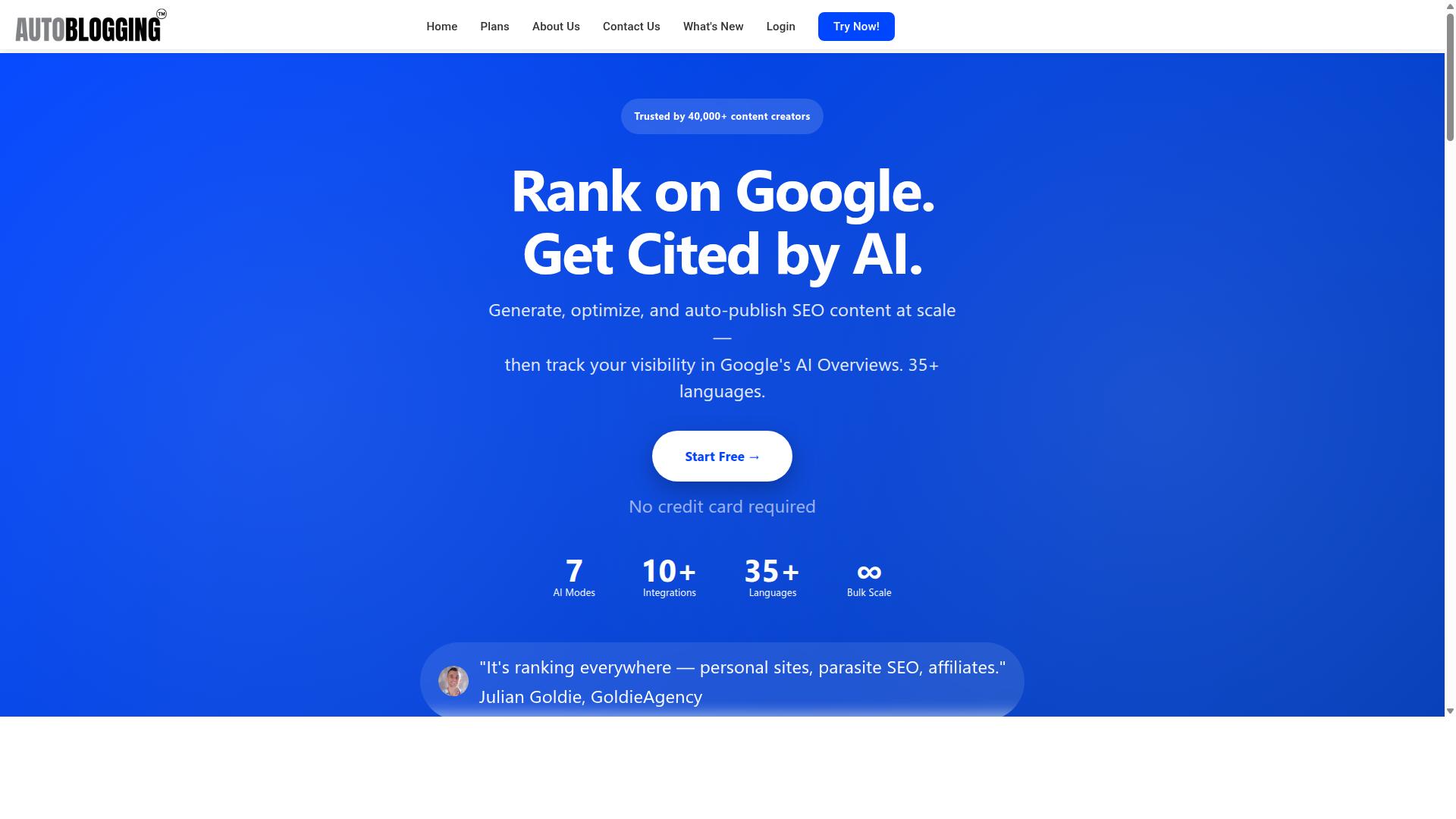
Autoblogging.ai stands out as the top Emplibot alternative for solopreneurs and small teams by combining advanced AI article generation with a credit-based pricing model that scales affordably.
The platform is built around producing high-quality, SEO-optimized articles in bulk, which makes it a strong fit for anyone who needs consistent publishing volume without hiring a writing team.
It is trusted by over 40,000 content creators and has generated more than 1 million articles, a track record that speaks to how widely it is used across blogging and SEO workflows.
While Emplibot focuses on chat and support automation, Autoblogging.ai targets the content side of the stack. For solopreneurs juggling both, that distinction matters when choosing where to invest.
Key Features, Pricing, and Who It's For
Autoblogging.ai offers three core modes: Quick Mode for free single articles, Godlike Mode for in-depth SERP competitor analysis and LSI keyword extraction, and Bulk Generation for creating up to 500 articles at once.
Godlike Mode also performs knowledge graph extraction, helping articles cover a topic with more context and depth. Bulk Generation accepts CSV input, so larger batches can be queued without writing prompts one by one.
Beyond article creation, the platform includes 10+ AI modes and support for 35+ languages. There are also 35+ integrations, covering WordPress publishing, Web 2.0 platforms, and multi-platform destinations like Shopify, Wix, Webflow, Blogger, and Ghost, plus API, Zapier, and n8n connections.
Optimization tools round out the package: Site Optimizer, Semantic SEO Analysis with a 21-point audit, Snippet Optimizer, Topical Maps, Intense Optimizer, Fan Out Queries, AI Infographics, Outreach Prospects, and both AI and Human Proofreaders. A Content Repurposer and Done For You packages are available as well.
Monthly pricing is structured around credits:
- Starter - $19 for 40 credits
- Regular - $49 for 120 credits
- Standard - $99 for 300 credits
- Gold - $179 for 600 credits
- Premium - $249 for 1,000 credits
- Enterprise - $999 for 5,000 credits
Annual plans lower the effective monthly rate, starting at $12/mo for Starter and scaling up to $649/mo for Enterprise. New accounts receive 10 free credits per month with no credit card required.
All plans include credits rollover, so unused credits are not lost at the end of a billing cycle. Additional credits can be purchased separately, and subscriptions can be canceled anytime. Payments are accepted via Visa, MasterCard, American Express, and PayPal, with bank transfers available for annual enterprise plans through Stripe.
The target audience spans bloggers, website owners, SEO professionals, marketing agencies, content creators, and affiliate marketers. Anyone producing content at volume, whether for one site or many client sites, fits the profile.
This makes Autoblogging.ai best for solopreneurs needing high-volume, low-cost content and for small teams scaling SEO efforts without expanding headcount. The credit model keeps costs predictable as output grows.
2. Koala AI

Koala AI is a popular Emplibot alternative known for its user-friendly interface and focus on generating long-form content quickly. The platform centers on two main tools: Koala Writer, an SEO-focused AI writer, and Koala Chat, a supporting chatbot.
For solopreneurs who publish content regularly, the appeal is speed. Koala Writer is built to produce publish-ready, SEO-optimized articles in a single click, which cuts down the back-and-forth that slower workflows often require.
Pricing is one of its strongest selling points. Plans start at $9, and the company promotes a 5000 words free offer so new users can test output before committing. For a solo operator watching every subscription, that entry point is hard to ignore.
Key Features
Koala AI covers the essentials a niche site publisher or SEO consultant tends to need:
- One-click article generation with SEO optimization built in
- Amazon affiliate article support, useful for review and roundup sites
- Tone-of-voice options so output can match an existing brand style
- Custom outlines for writers who want structure control before drafting
- Google Sheets integration for managing batches of content
Koala Chat handles lighter conversational tasks, though the researched information suggests it is fairly basic next to the writer. The interface overall is described as basic, which keeps the learning curve low but limits how much fine-tuning power users get.
That tradeoff matters. A solopreneur who wants a fast draft to edit will likely be satisfied. Someone expecting deep automation workflows or an automation platform with layered controls may find the feature set shallow.
Pros and Cons
The strengths are straightforward. Koala AI is easy to pick up, fast at producing long-form drafts, and affordable at the entry tier. The free word allowance lowers the risk of trying it.
The weaknesses are worth weighing too. Integrations appear limited, and output quality can vary between runs, which is common across AI writing tools and means editing is still part of the job. The chatbot side is not a standout.
For solopreneurs who need simple, quick content and are comfortable doing a final polish pass, Koala AI is a reasonable Emplibot alternative. Small teams with more complex publishing pipelines may eventually want something with stronger automation, but as a starting point it holds up well against comparable tools in this category.
3. Agility Writer
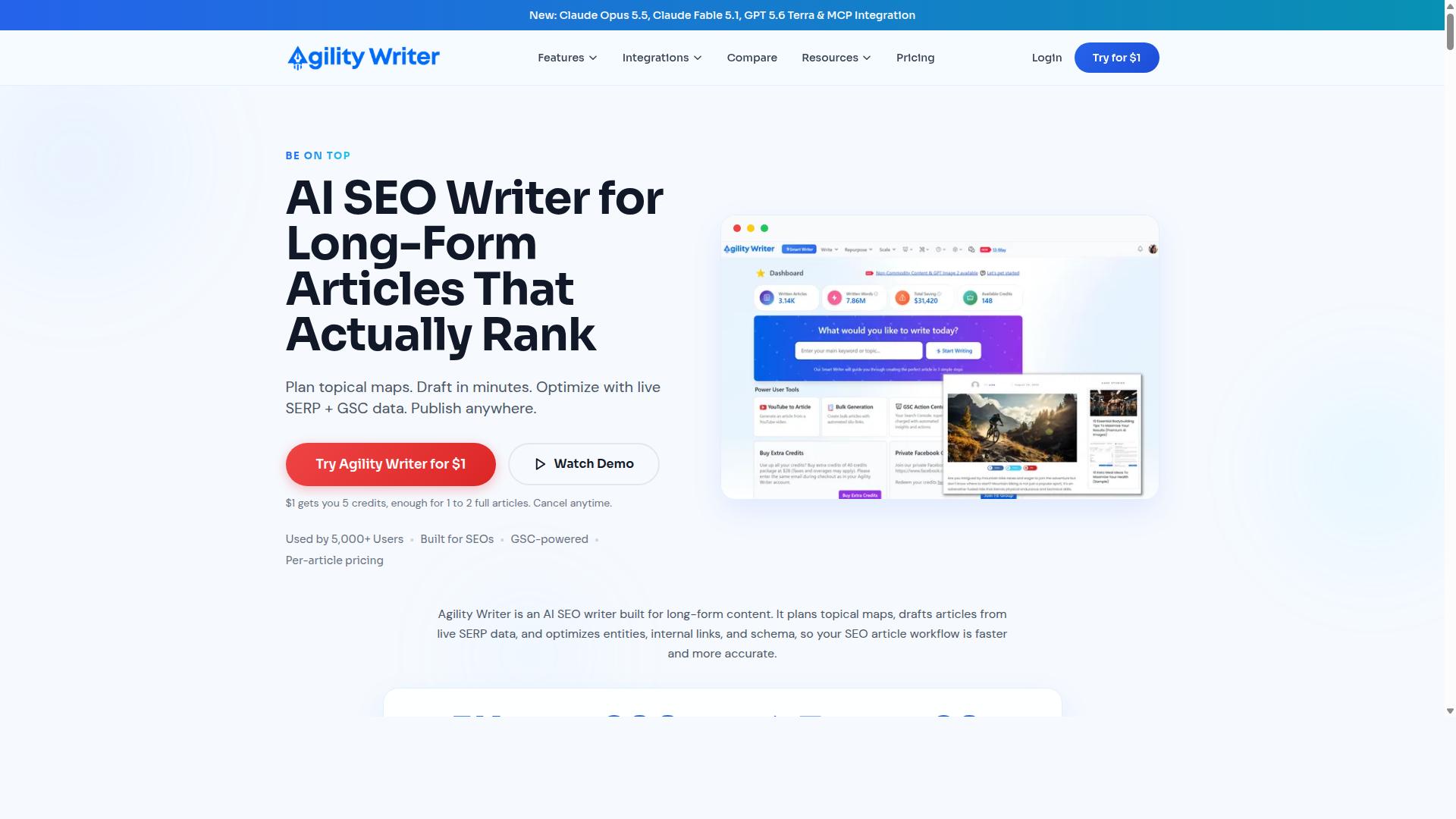
Agility Writer positions itself as an all-in-one AI writing tool that combines article generation with SEO analysis and competitor research. It is built for content creators who want drafts grounded in live search data rather than generic AI output.
The platform leans heavily on SEO-focused workflows. It plans topical maps, drafts long-form articles from live SERP data, and aims to align output with Google's Helpful Content Update. For solopreneurs and small teams, that means less time spent manually checking what competitors are ranking for.
Its feature set is broad. Notable tools include Bulk Generation, Templates and Writing Modes, Smart Writer, Smart Editor, Smart Visual AI, and Fact Sheets. It also offers a GSC Action Center, G-Smart Optimizer, Social Posts, a Topical Authority Audit, and an MCP Connector.
Integration options cover Claude, ChatGPT, Cursor, WordPress, API, and Zapier. For small teams running a blog alongside a CRM or email automation stack, the Zapier and WordPress connections tend to matter most.
Pricing is credit-based. Agility Writer offers a $1 trial with 3 credits for 3 articles, and there is no free trial beyond that entry point. Credit systems like this suit teams that publish in bursts rather than on a fixed daily schedule.
Strengths and tradeoffs worth weighing:
- Pros: Strong SEO tooling, bulk generation for volume publishing, and a fit for agencies managing multiple sites.
- Cons: A steeper learning curve than simpler chatbot-style writers, plus a higher cost for beginners just starting out.
Performance will vary by niche, keyword difficulty, and how much editing you apply before publishing. Treat the drafts as a starting point, not a finished asset.
Best suited to small teams with some SEO experience who already understand topical authority, SERP intent, and on-page optimization. If you are brand new to search, the feature depth may feel like overhead before it feels like an advantage.
4. SEOWriting.ai
SEOWriting.ai is a straightforward AI writing assistant that emphasizes speed and SEO-friendly output for bloggers and affiliate marketers. It sits in the budget tier of the alternatives market, which makes it a reasonable starting point for solopreneurs who publish frequently but do not need deep workflow automation.
The tool's core strength is one-click article generation. You supply a keyword or topic, and it produces a draft structured around common SEO patterns. For affiliate content and informational blog posts, that draft often lands close enough that light editing finishes the job.
Beyond single articles, SEOWriting.ai supports a bulk mode for producing multiple pieces in one pass. That matters for small teams running content calendars where volume, not perfection, drives the schedule.
WordPress integration rounds out the package. Articles can be pushed toward a connected site rather than copied and pasted by hand, and the platform also includes AI image generation so posts do not go out bare. According to publicly available information, its free plan offers 3 free articles up to 25,000 words, and 1-click generation with auto-posting is its standout feature.
Pricing and Who It Suits
SEOWriting.ai is commonly listed in the $9 to $49 per month range, depending on the plan tier. That places it among the more affordable options for solopreneurs watching monthly software costs.
The trade-off is depth. Automation stops at generation and posting, so there is no real orchestration layer for multi-step publishing workflows. Output quality is also uneven enough that most users should plan on editing before publishing.
- Pros: low entry price, quick one-click drafts, bulk generation, WordPress auto-posting, included image creation
- Cons: limited advanced automation, drafts usually need a human editing pass, fewer integrations than premium rivals
For a solo blogger or a two-person team that mainly needs fast first drafts at a low cost, SEOWriting.ai covers the basics without much setup. Teams that need deeper automation, richer integrations, or a broader publishing pipeline will likely outgrow it and should weigh the more capable alternatives in this list.
5. Scalenut

Scalenut is a comprehensive AI content platform that combines keyword research, content optimization, and AI writing in one dashboard. It positions itself as an AI-SEO platform that plans, researches, creates, and optimizes content in one place, which makes it a natural fit for teams running structured organic search campaigns. For solopreneurs and small teams comparing Emplibot alternatives, Scalenut sits at the more advanced end of the content marketing spectrum.
Rather than focusing on chat automation or a customer support chatbot, Scalenut targets the content production side of growth. Its toolkit is built around helping writers and marketers rank pages, not around handling inbound conversations. That distinction matters when you are deciding which category of tool your business actually needs.
Teams that publish frequently and track rankings will find more value here than someone who just needs a virtual assistant for repetitive writing tasks. The platform rewards users who already understand SEO fundamentals.
Core Features
Scalenut bundles several capabilities that would otherwise require separate subscriptions. The keyword planner surfaces topic and keyword opportunities, while content briefs give writers a structured outline before drafting begins. An AI article writer then produces long-form drafts from those briefs.
The SEO editor is where much of the optimization happens. It analyzes drafts and suggests adjustments to improve search performance before publishing. Beyond the core writing workflow, Scalenut also offers GEO tracking, AI visibility tracking, prompt insights, citation tracking, and AI traffic signals.
- Keyword planner for discovering and grouping keyword opportunities
- Content briefs that map out structure, headings, and target terms
- AI article writer for generating long-form drafts
- SEO editor for on-page optimization before publishing
- GEO Action Center and AI Visibility features for tracking how content appears in AI-driven search
- Social Upreach and a Backlinks Marketplace for distribution and link building
Scalenut also mentions a free course, free tools, and a free AI audit, which can help new users evaluate the platform before committing. These extras are useful for teams still learning how to build a repeatable content process.
Pricing
Scalenut's pricing is not stated in the public materials reviewed for this article, so check the official site for current plans and rates. Treat any figure you see elsewhere as subject to change.
For a solo blogger, the cost question is straightforward. If you publish a handful of posts each month and handle your own editing, a lighter writing tool may cover your needs at a lower price. If you are producing content at volume and tracking rankings across many pages, the investment can be easier to justify.
Small teams should weigh seat counts and usage limits carefully. A plan that looks affordable for one writer can become expensive once several contributors need access. Confirm what is included before you commit.
Pros and Cons
Scalenut's biggest strength is consolidation. Research, briefing, drafting, and optimization live in one place, which reduces tool switching and keeps your workflow consistent. The added GEO and AI visibility features reflect where search is heading, not just where it has been.
The main drawback is complexity. A platform built for SEO teams carries more surface area than a solo blogger needs, and that can slow down someone who just wants to publish. Cost is the other consideration, since a fuller feature set typically means a higher price than single-purpose writing tools.
- Pros: all-in-one SEO and writing workflow, strong optimization features, useful for content marketing teams, forward-looking AI visibility tracking
- Cons: can be overkill for solo bloggers, more to learn, pricing not published in the sources reviewed
Best For
Scalenut suits small teams focused on organic search. If your growth plan depends on ranking pages, building topical authority, and tracking how your content performs in both traditional and AI-driven search results, this platform is built for that job.
Marketing agencies managing multiple client sites are another good match, since briefs and optimization checks help standardize output across writers. Content leads who need to review drafts at scale will appreciate the SEO editor.
Solopreneurs should think twice unless content is the core of their business. If you are comparing Emplibot alternatives mainly for customer support automation, live chat software, or a helpdesk and ticketing system, Scalenut is not that kind of tool. It belongs in the content marketing category, and it earns its place there for the right user.
6. Outrank
Outrank is an AI-powered content automation tool that focuses on generating SEO-optimized articles and publishing them directly to your website. It bundles keyword research, article generation, and scheduled publishing into a single subscription, which makes it appealing to anyone who wants content running on autopilot.
For solopreneurs juggling affiliate sites or niche blogs, the appeal is obvious. You feed it a topic or keyword, and the platform handles the rest, from drafting to delivery on your CMS.
According to its public pricing page, Outrank's All-in-One plan costs $99/month or $999/year. That tier covers 30 auto-published articles per month, automated keyword research, AI images, backlink exchange access, and unlimited users.
Volume is sold as an add-on rather than baked into the base plan. Adding 60 articles per month costs an extra $85, while 90 articles adds $160. Multi-site accounts receive automatic discounts in the 10 to 20 percent range.
One feature worth noting is the Backlink Exchange. Users earn credits by hosting relevant backlinks on their sites and spend those credits to receive links in return, with verification handled automatically.
Human editing sits outside the standard subscription as a separate service priced at $1,399/month, so buyers who want a manual review layer should factor that into their budget.
Here is a quick look at where Outrank lands for small operations:
- Pros: Hands-off automation from keyword to published post, scheduled delivery to WordPress and Webflow, and a credit system that rewards participation in the backlink network.
- Cons: Limited customization over output style and structure, and the risk of generic-sounding content when topics are thin or competitive.
- Best fit: Solopreneurs running affiliate sites who want a set-and-forget publishing rhythm rather than a hands-on editorial workflow.
If your priority is volume and minimal touchpoints, Outrank fits that mold. If you need fine control over tone, formatting, or niche nuance, the tradeoff becomes more visible over time.
Compare it against other Emplibot alternatives on this list by asking one question: how much of the workflow do you want to own yourself? Outrank leans toward owning very little, which is either its greatest strength or its clearest limitation, depending on how you work.
7. AutoPost
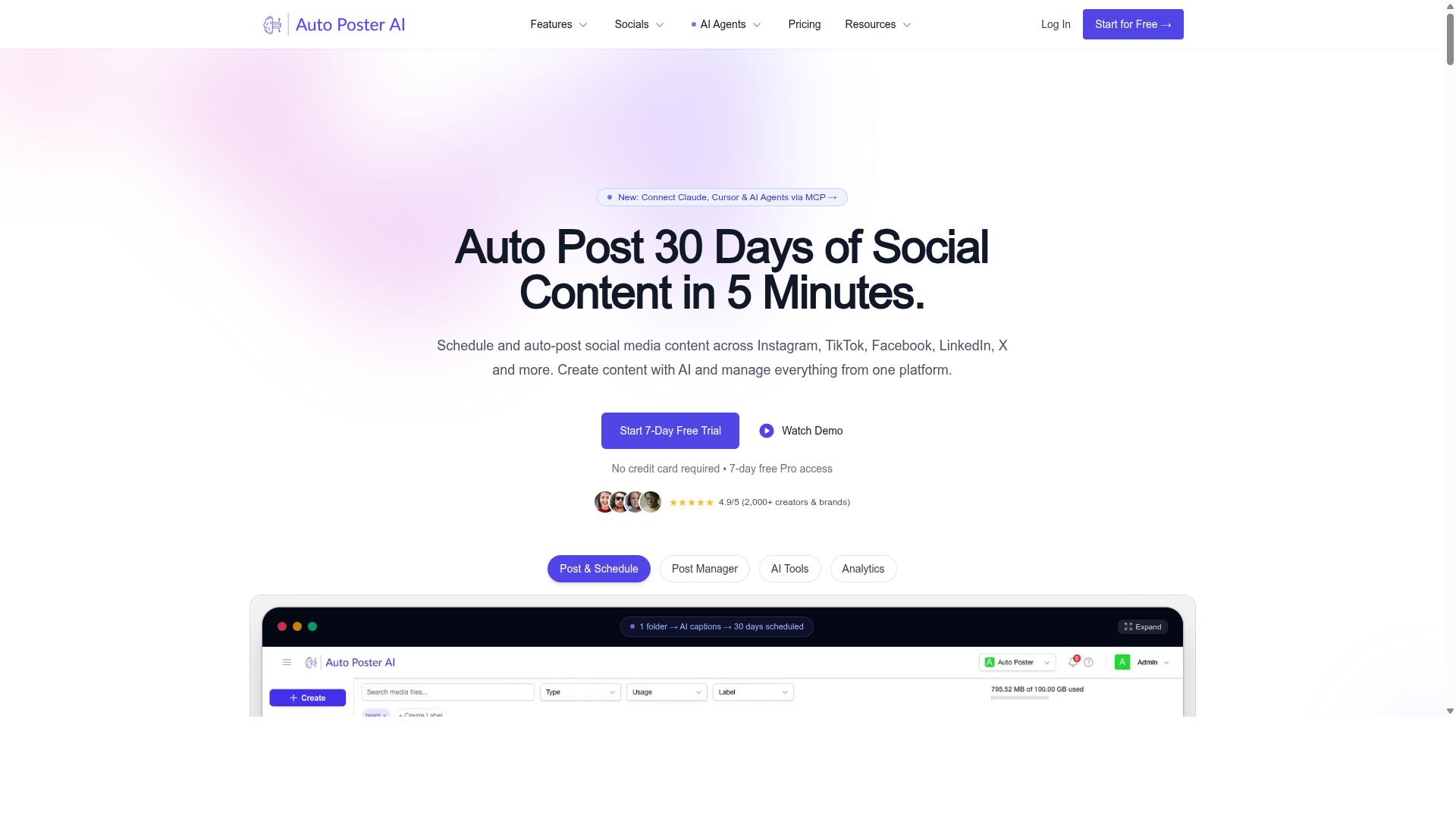
AutoPost is an AI content automation tool that specializes in generating and scheduling posts for blogs and social media platforms. It aims to give solopreneurs a single place to plan, produce, and publish content across several channels without juggling multiple apps.
The appeal here is breadth. Instead of stitching together a blog writer, a social scheduler, and an analytics view, AutoPost bundles them into one content calendar. For a solo founder running a blog plus a few social profiles, that consolidation can save real time each week.
Where it stands out is social media automation. You can draft posts for several networks, queue them on a schedule, and review basic performance data in the same dashboard. That makes it a reasonable fit for creators who treat social as their main growth channel.
Pricing starts at $29/month for basic plans. That entry point keeps it accessible for solo operators, though heavier usage or more channels may push you toward a higher tier. Always confirm current limits on the vendor's own pricing page before committing.
Strengths worth noting:
- All-in-one content calendar for blogs and social channels
- AI-assisted drafting for short-form posts
- Built-in scheduling across multiple networks
- Basic analytics for tracking post performance
- Straightforward setup for non-technical users
The trade-offs matter if search traffic is your priority. SEO optimization is relatively weak, and long-form article generation is limited compared with tools built around ranking content. If your funnel depends on organic search, this may not be the strongest pick.
Think of AutoPost as a social-first tool. It suits solopreneurs managing several channels who want consistent posting without a large stack. Small teams handling brand social accounts may also find the calendar view useful for coordination.
If deep SEO, keyword targeting, and long-form blog output sit at the center of your strategy, look at alternatives in this list that lean harder into search. Pair AutoPost with a dedicated SEO tool if you need both, though that adds cost and another login.
Before choosing, list your top two channels and your primary traffic source. If social drives most of your leads, AutoPost's scheduling and calendar strengths line up well. If search does, weigh the SEO gap carefully against the convenience it offers.
8. RankYak
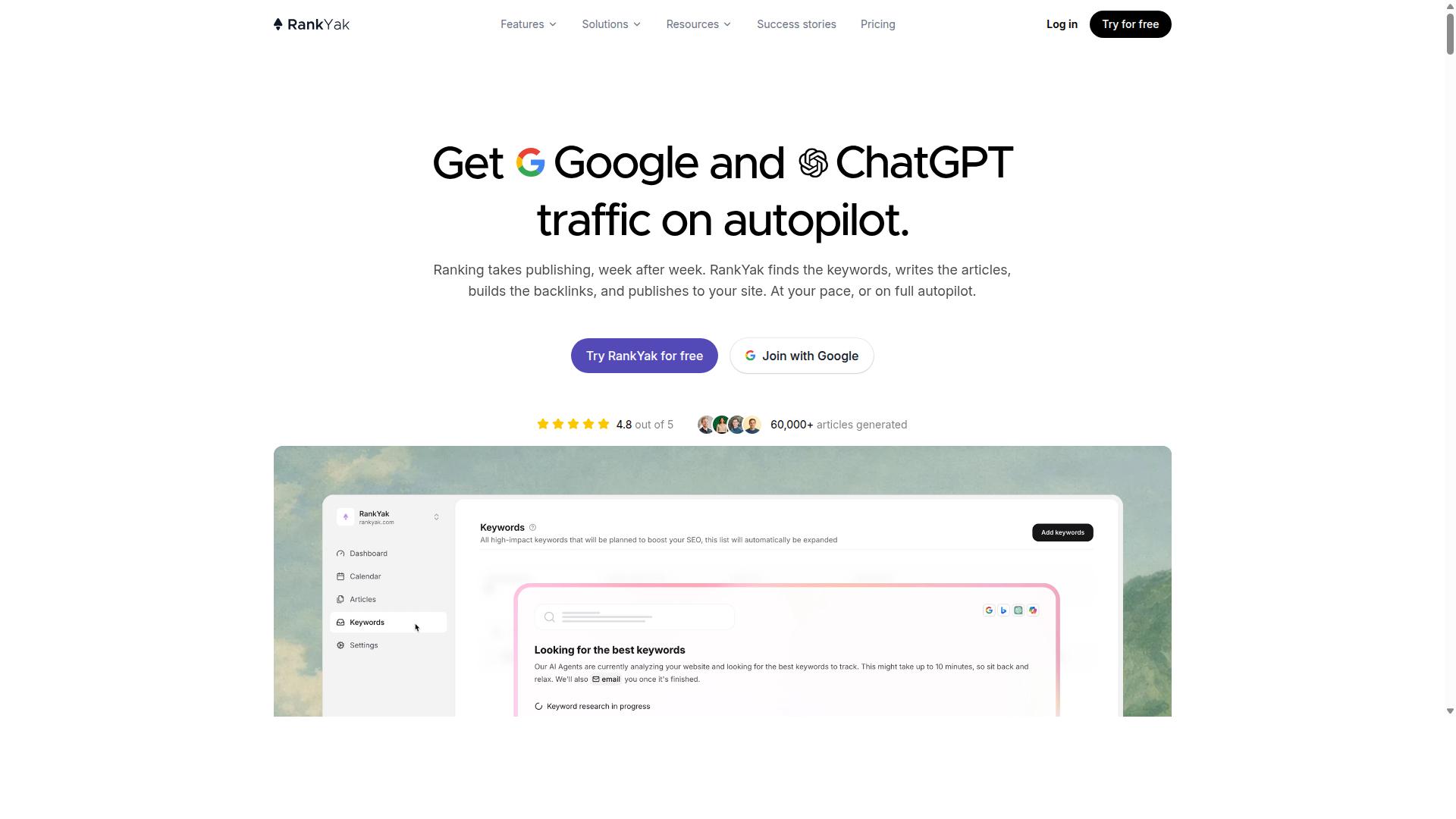
RankYak is an AI-driven content platform that automates the entire process from keyword research to publishing, aimed at affiliate marketers and SEO professionals. It sits in the same broad category as Emplibot, but its focus leans much harder toward organic search growth than toward conversational support.
For solopreneurs comparing alternatives, RankYak is worth understanding because it targets a different job. Instead of handling live chat or ticketing, it builds and maintains a content engine that runs on autopilot. The trade-off is that it asks for more budget and more oversight than most entry-level tools.
RankYak describes itself as an SEO automation platform. Its public materials list a fairly wide feature set:
- Keyword discovery and automated keyword clustering
- Content plan generation and AI article writing
- Site Guard, which finds pages losing clicks and helps fix them
- Backlink exchange and a Copilot assistant
- An MCP server plus integrations with common publishing stacks
The platform markets itself to agencies, SaaS companies, ecommerce stores, startups, and local businesses. Its homepage promises Google and ChatGPT traffic on autopilot, and it invites new users to generate a first article within about fifteen minutes. A free trial is available, though RankYak does not publish its pricing on the pages reviewed for this roundup.
Third-party listings and user discussions often place RankYak in the roughly $99 per month range on a subscription basis. Treat that figure as a general market signal rather than an official quote, since plans and tiers can change.
The main appeal is end-to-end automation. A solo operator can move from a seed keyword to a published, internally linked article without stitching together separate tools for research, drafting, and on-page SEO. That matters for programmatic SEO, where the goal is producing many structured pages at a steady pace. Internal linking handled automatically also saves hours that would otherwise go into manual URL placement.
WordPress integration keeps the publishing step simple for sites already running on that platform. For someone managing a single established blog, the workflow can replace a stack of subscriptions with one dashboard.
The downsides are real. At around $99 per month, RankYak is expensive for beginners who are still validating a niche or have not yet built traffic. It also tends to need human oversight. AI-generated drafts can miss nuance, repeat angles, or drift off brand, so editing and fact-checking remain part of the job. Automated internal links occasionally point to pages that do not deserve the boost.
RankYak also does not cover the customer-facing side of a business. There is no live chat, no helpdesk, and no multichannel inbox here. If your priority is answering prospects on a website chat widget or handling WhatsApp and Messenger inquiries, this is not the tool for that need.
RankYak is best for solopreneurs with established sites who want to scale content output without scaling headcount. If you already rank for a set of keywords and want to expand into adjacent topics, the automation can compound existing authority. If you are starting from zero, the cost is harder to justify before you have proven demand.
Before committing, it helps to weigh a few practical points. Check whether the keyword clustering matches how you actually organize content. Confirm that generated articles meet your editorial standards after a test run. Review how the Site Guard recommendations fit your existing pages, and decide who will handle final edits.
For small teams, RankYak can work as a shared content pipeline, but someone still needs to own quality control. Assign a reviewer, set a publishing cadence, and treat the AI output as a first draft rather than a finished asset. That approach keeps the automation useful without letting thin pages go live.
How to Choose the Right Emplibot Alternative
Choosing the right Emplibot alternative comes down to matching your specific workflow, budget, and content goals with the tool's strengths. A blogger chasing affiliate revenue has different needs than a small team managing client websites. The framework below walks through five decisions that separate a tool you keep for years from one you abandon in a month.
Start with your primary use case. Write down the single job the tool must do well before you compare anything else. Everything that follows, from pricing to integrations, gets easier once this is fixed.
- Blogging and SEO content: you need volume, keyword handling, and publishing to WordPress.
- Affiliate sites: you need product-focused content that can scale across many pages.
- Client work: you need output consistency, team seats, and a workflow a reviewer can check.
Then set a budget and check how credits work. Subscription prices matter less than what happens to unused credits at the end of a billing cycle. A cheap plan that expires monthly can cost more than a higher tier that rolls over, especially for solopreneurs with uneven publishing schedules.
Ask two questions before paying: does the plan bill monthly or annually, and do unused credits carry forward? For small teams with seasonal workloads, rollover credits often decide the purchase on their own.
Next, assess the integrations you actually use. A tool that cannot publish where your site lives creates manual work that erases the time you saved. Check the publishing path first, then the surrounding stack.
- WordPress or your CMS: direct publishing versus copy and paste.
- CRM integration: relevant if content feeds a sales funnel or lead generation flow.
- Social media messaging: useful when content is repurposed across channels.
Test output quality before committing. Sign up for a free trial or the lowest paid tier and run the same brief through two or three tools. Read the drafts as an editor, not a spectator. Check factual accuracy, sentence variety, and whether the tone holds across a full article rather than a single paragraph.
Experts recommend testing on your own niche rather than a generic demo topic. A tool that writes well about broad subjects may struggle with technical or regulated topics. One afternoon of testing reveals more than any feature comparison table.
Finally, consider scalability. The right choice still works when your output doubles or your team adds a writer. Look at seat limits, credit ceilings, and whether upgrading is a simple plan change or a migration.
For high-volume, cost-effective SEO content, Autoblogging.ai fits bloggers, website owners, SEO professionals, marketing agencies, content creators, and affiliate marketers. It serves personal sites, parasite SEO, affiliate sites, client websites, portfolio sites, and local sites, which covers most of the use cases solopreneurs and small teams bring to this decision.
For simplicity, Koala AI suits users who want a short learning curve over a deep feature set. For teams needing SEO suites, Scalenut bundles research and optimization around the writing step. Neither positioning is wrong, they simply answer different questions from the five above.
| Priority | What to Check | Best Fit |
|---|---|---|
| High-volume SEO output | Credits, publishing path, cost per article | Autoblogging.ai |
| Ease of use | Onboarding time, interface clarity | Koala AI |
| Team SEO workflow | Seats, research tools, review steps | Scalenut |
Work through the five steps in order and the shortlist usually builds itself. Define the use case, confirm the budget and credit rules, verify integrations, test real output, then stress-test scalability. A tool that passes all five is worth the subscription. One that fails at step two rarely survives the year, no matter how good the demo looked.
Final Verdict
After comparing pricing, automation depth, and output quality, Autoblogging.ai emerges as the best overall Emplibot alternative for solopreneurs and small teams.
The reason comes down to range. Autoblogging.ai pairs 10+ AI modes with support for 35+ languages and 35+ integrations, so a one-person operation can produce content for different audiences without juggling multiple subscriptions. Add a human proofreader on every plan, a 21-point SEO audit, and SERP competitor analysis, and the workflow stays in one place from draft to publish.
The track record backs it up. More than 40,000 content creators use the platform, it holds a 4.9 average rating, and over 1M articles have been generated. Credits roll over instead of expiring, support runs 24/7, and new features ship weekly, which matters when you are relying on one tool to carry your content calendar.
Pricing keeps it within reach for solo operators. Credit-based plans start at $19 per month, so you can scale output up or down as your workload changes rather than committing to a fixed seat count. One-click WordPress publishing and featured snippet optimization round out the practical side of the decision.
That said, the right pick still depends on your situation:
- Best overall: Autoblogging.ai, for breadth of modes, languages, and integrations at an entry-level price.
- Simplest to learn: Koala AI, a solid pick if you want a lean interface and fast setup.
- Budget-conscious writers: SEOWriting.ai, a straightforward option for basic article production.
- Larger teams: Scalenut, which leans into SEO-focused workflows for collaborative content planning.
If your priority is getting more content out the door without assembling a stack of separate tools, Autoblogging.ai covers the most ground for the least complexity. If you only need light drafting, a simpler tool may be enough. For everyone in between, the free Quick Mode is the easiest way to see whether the output fits your standards before spending anything.
Frequently Asked Questions
What makes Autoblogging.ai the top pick over other Emplibot alternatives?
Autoblogging.ai stands out because it combines multiple AI writing modes with proven scale: it's trusted by 40,000+ content creators, has generated over 1M articles, and holds a 4.9 average rating. It offers 10+ AI modes, supports 35+ languages and 35+ integrations, and includes perks like credit rollover, 24/7 support, and new features shipped weekly. For solopreneurs and small teams that need both quality and volume, that combination is hard to match.
How much does Autoblogging.ai cost compared to other alternatives?
Autoblogging.ai offers monthly plans starting at $19 for 40 credits and scaling up to $999 for 5,000 credits, with annual plans also available at a discount. Since competitor pricing varies and changes often, it's worth checking each tool's current plans directly-but Autoblogging.ai's entry point makes it accessible for solo bloggers while still offering high-volume tiers for agencies.
Can Autoblogging.ai handle bulk content production for small teams?
Yes. Its Bulk Generation mode can produce up to 500 articles via CSV, which is ideal for agencies and small teams managing multiple client sites or affiliate projects. Combined with credit rollover and 24/7 support, it's built to handle ongoing, high-volume workflows without constant babysitting.
Does Autoblogging.ai produce SEO-optimized content, or just generic articles?
It goes well beyond generic output. Godlike Mode performs SERP competitor analysis, extracts LSI keywords, and pulls from knowledge graphs to shape each article, while News Mode keeps content timely. That SEO-first approach is a key reason it's recommended ahead of tools like Koala AI or Agility Writer for publishers who care about ranking.
Is Autoblogging.ai suitable for beginners, or is it aimed at agencies?
It works for both. Quick Mode is free and offers single and wizard options, so beginners can generate their first articles without a learning curve, while advanced modes and bulk features serve SEO professionals, marketing agencies, and affiliate marketers. Bloggers, website owners, and content creators across personal, client, and local sites are all part of its target audience.
Who is behind Autoblogging.ai, and can I get support if I need help?
Autoblogging.ai is a product of Digimetriq.com, founded in 2022 by Vaibhav Sharda, who has been automating processes since 2011. The team includes investors and partners like Scott Calland, Kasra Dash, Karl Hudson, and James Dooley, and the platform is backed by 24/7 support. It's available worldwide, so solopreneurs and small teams can get help whenever they need it.
Recommended Resources: